
Belgravia Mews: A Victorian Office, Reworked for Modern Working Life
A tired office in a Victorian Belgravia mews, behind one of the area’s grand listed terraces, reworked by 4SA: reglazed, opened to its historic roof trusses, taken off gas, and given a character a prospective tenant remembers. This is the story of how 4SA secured permission and repositioned the asset.
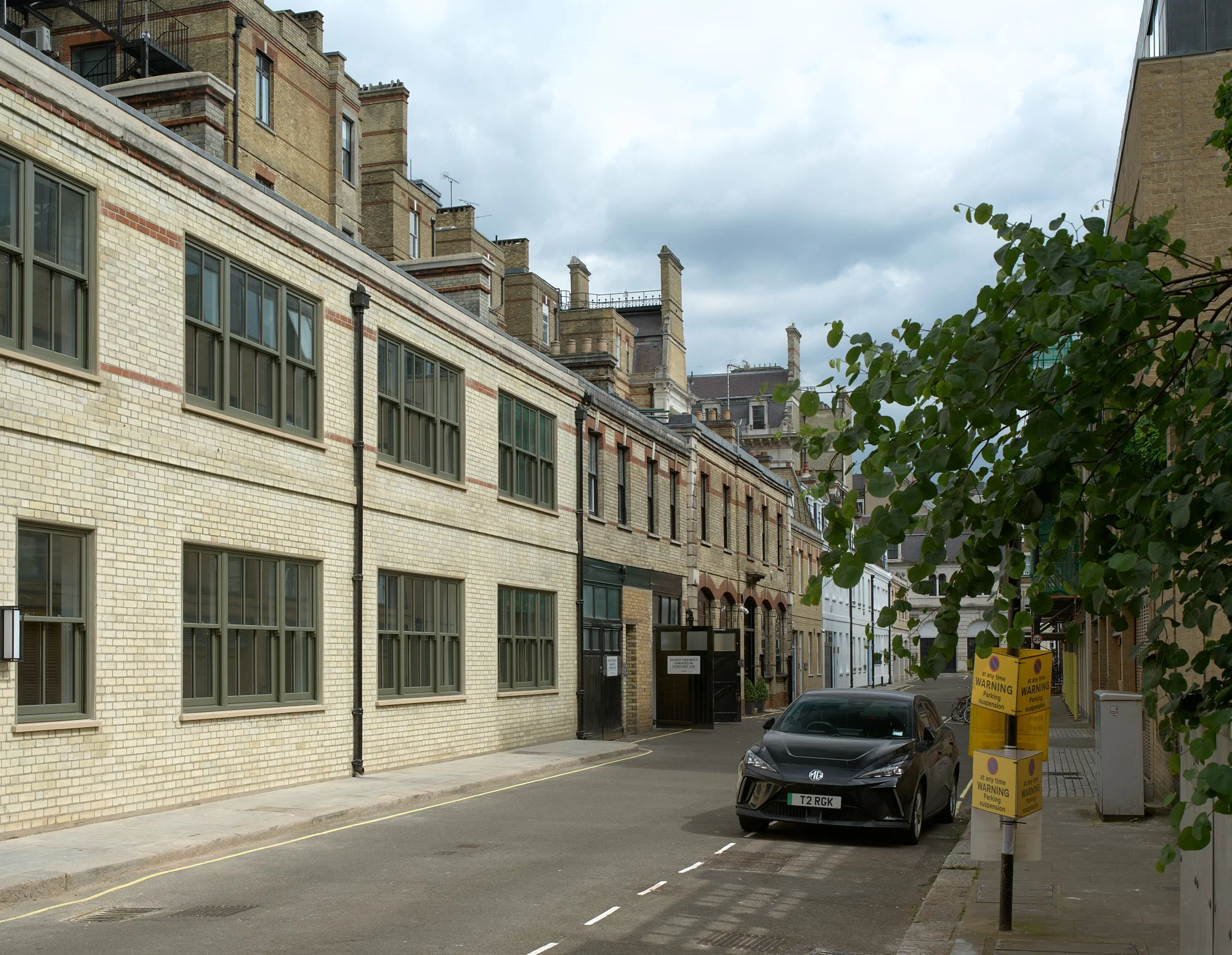
Belgravia Mews is a Victorian former mews on Headfort Place, running behind Grosvenor Place just south of Hyde Park Corner. Originally the stable block and coach house serving the grand terrace in front of it, it was refurbished after the war into offices. By the time 4SA was appointed it had a familiar problem for a heritage building in central London. It was tired, dated, and difficult to let well, hemmed in by its setting on every side.
The asset manager’s brief was direct. Refurbish the building so it appeals to a contemporary office occupant, improve its environmental performance, and navigate a smooth planning journey in a sensitive central London setting. 4SA was appointed across RIBA Stages 1 to 6, from preparation and brief through to delivery on site and handover. What follows is less a story about a refresh and more about judgement: where to hold a line, where to concede, and how to make a constrained building memorable.
The planning question came first
The building is unlisted. What it presented instead was an interesting mix: a Victorian facade enclosing a 1950s interior, complete with a terrazzo staircase, terrazzo floor tiles, and mid century modern metal staircase railings. It stands directly behind a Grade II listed terrace at Grosvenor Place, and the Belgravia Conservation Area begins just past it along the street. Every external change had to be justified by its effect on those heritage assets.
4SA built the planning case on a deliberate heritage gain. The post-war steel-frame street windows, single glazed and thermally poor, with their horizontal emphasis and projecting panes, were out of step with the rhythm of timber sash windows that defines the rest of the eastern side of the street. 4SA proposed removing them and reinstating the removed brick piers and double-glazed timber sash windows that replicate the proportions of the neighbouring Victorian originals. The effect is a street elevation that reads coherently again, and a demonstrable improvement to the setting of the adjacent Conservation Area.
That enhancement became the fulcrum of the application. The more functional interventions the building actually needed, replacement plant in the rear lightwell and conservation rooflights to the rear roof slopes sit out of public view and were assessed as causing no harm. Set against the visible heritage gain at the front, the proposal read as a net benefit. Permission was granted without objection or refusal.
The services strategy: a collaboration with the engineers
The heart of the repositioning was technical as much as aesthetic. The servicing strategy was chosen for how it would look and feel in the space, not only for how it would perform.
Working closely with the services engineers, 4SA developed and tested four distinct servicing strategies. They ranged from exposing the ducts and units overhead, where they could sit within the roof structure, to concealing the whole distribution in a raised access floor. Each was weighed against the trade-offs that matter to a letting: ceiling height, lettable floor area, look and feel, and whether the floors could be let or sublet separately. 4SA presented clear diagrams of each option so the letting agents could assess them against the demands of the specific local market.
The two strongest servicing options were refined and the final scheme resolved with the asset manager and the letting agents. Perimeter fan coil units in slim housings sit on a raised access floor, concealing the pipework runs as well as the usual power and data, maintaining the first-floor ceiling height, and protecting the net lettable area. The result is a building with the kind of warehouse character you might find in Shoreditch, but softened for the Belgravia letting market. Because natural ventilation does much of the work and the fan coil units are housed around the perimeter, there is none of the raw, over-ducted ceiling scape that a fully exposed strategy would have imposed.
Revealing the building’s historic structure
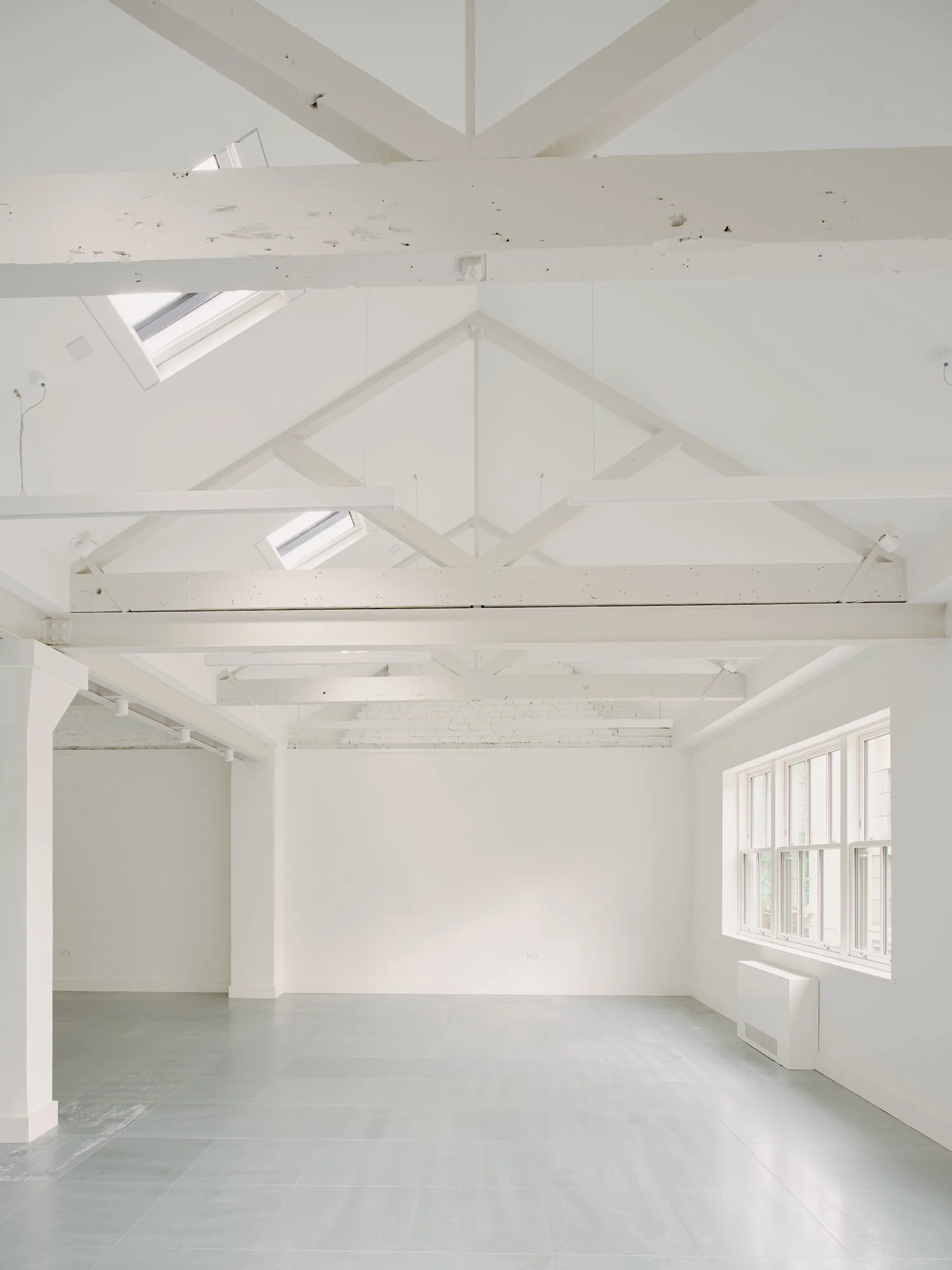
At the first floor, the post-war suspended ceiling was removed to reveal the building’s historic timber roof trusses across a double-gabled pitched roof. The aesthetic carries through with exposed trusses and raw painted brickwork: the trusses painted white to emphasise the drama of the height, and the party wall brickwork exposed and painted white to add texture and depth. Materials already in the building were put to work.
A palette drawn from the building’s historic fabric
The interior is where a well-executed refurbishment becomes a genuine repositioning, and where 4SA set out to make Belgravia Mews memorable. The target tenant in this bracket will have walked through a great many white boxes. The aim was that they would leave remembering this one.
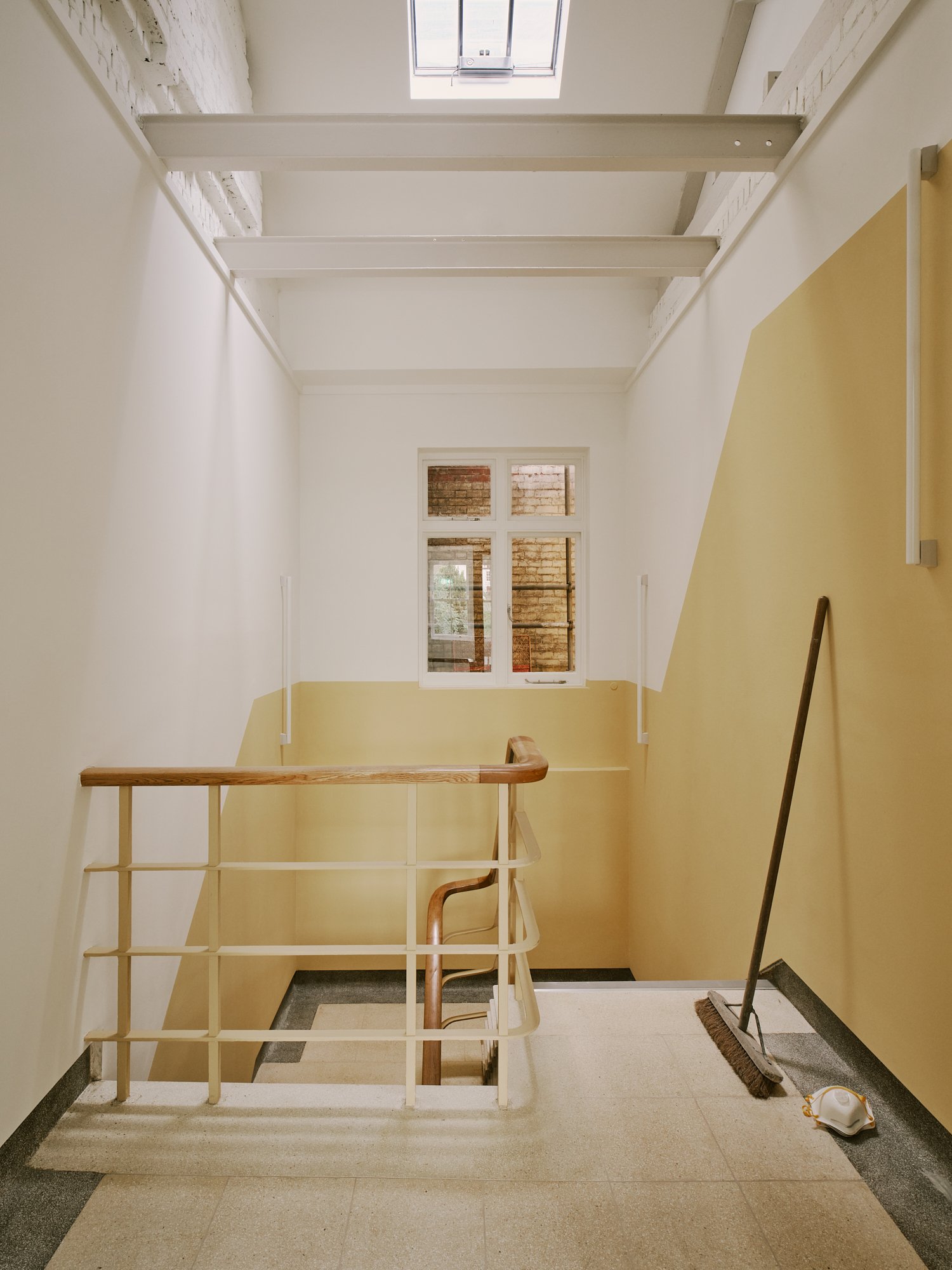
The existing post-war terrazzo staircase was retained, cleaned and treated as the high-quality element it is, honouring the building’s later layer rather than stripping it back. From the terrazzo chips themselves 4SA drew the building’s accent colour, a mustard yellow, used on the stair balustrade uprights and on selected walls. New terrazzo floor tiles in the reception draw from the original but were chosen a shade darker, so old and new read as distinct rather than as a failed match. The original handrail was restored in oak, and the reception joinery and unit door frames were finished to match that oak in tone, tying the entrance together.
Crucially, the colour was used with restraint. The mustard appears only where it draws directly from the building’s fabric, and only in small areas that make the letting viewing easy to remember, but that a tenant could change cheaply and easily. The interiors are otherwise kept bright and white, so an incoming tenant can put their own stamp on the space.
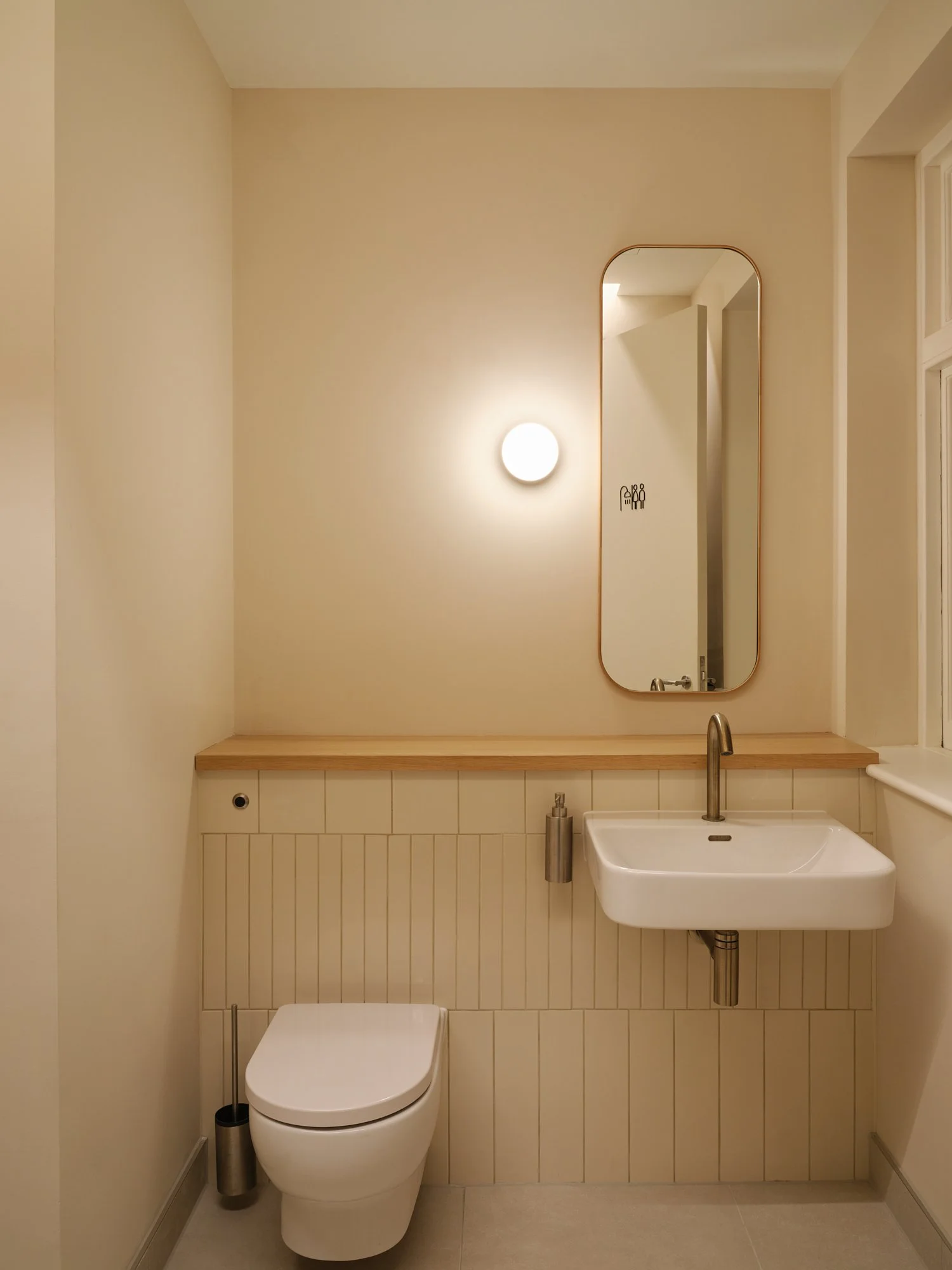
In the toilets, an economical vertical tile is laid in varying sizes to create an interesting pattern. Using an inexpensive material in an inventive way to elevate its quality is a technique we often use at 4SA when budget matters. Thoughtful design, working hardest in even the smallest spaces.
Sustainability that stands up
To improve the building’s Energy Performance Certificate (EPC), the existing gas boiler was removed, taking fossil fuel out of the building entirely in favour of an all-electric system. At the front, single glazing became double-glazed timber frame sash windows. At the rear, existing timber windows were retained, draught proofed, and restored where they were serviceable rather than replaced to minimise the embodied carbon of new glass. With a shallow floorplate on a quiet street, 4SA collaborated with the services engineers and pushed for natural cross ventilation in place of a mechanical system, with the operable rooflights venting accumulated heat for night-time cooling. Less plant, less energy, and a building that breathes. Together, these measures lifted the building's rating from EPC C to EPC B.
Honouring the past, designing for the future
Belgravia Mews is a small building that asked a lot of questions. It shows how a heritage-led practice adds value to a commercial asset and how its done: we read the constraints, find the gains, resolve the services properly, and re-instate original character. At 4SA we are rigorous where it counts, responsive throughout, and collaborative with the whole team including the asset manager, the letting agents and the engineers from first sketch to handover as this is what we believe ensures a successful project.
“We have worked with 4SA to add value to a number of challenging heritage properties, including the Grade II listed buildings at Pall Mall, Grosvenor Place and Ulster Terrace, as well as this mews property in Belgravia. With their knowledge of historic buildings, and their commitment to high-quality design, 4SA developed innovative design solutions that were granted listed building consent. 4SA are a reliable practice with a collaborative attitude, working seamlessly with us and letting agents to take on board market-led design requirements throughout the process. Their ability to respond quickly on site to unexpected conditions also ensures that opportunities to add value are taken advantage of, and the project progresses smoothly through construction to a successful end product.”
Stuart, Asset Manager
Frequently asked questions
Was the building listed?
No. The building is unlisted and sits outside the Belgravia Conservation Area, though only just. It stands directly behind a Grade II listed terrace at Grosvenor Place and within the setting of the Conservation Area, so its external changes were still assessed for their effect on those heritage assets.
How did 4SA secure planning permission in such a sensitive location?
By leading with a heritage gain. Reinstating timber sash windows in place of the post-war steel frames visibly improved the street and the setting of the adjacent Conservation Area, and that enhancement was used to offset the more functional interventions. The application was granted without objection or refusal.
Did 4SA lose any lettable space to the new servicing?
No. The servicing strategy was chosen partly to protect the net lettable area, concealing distribution in a raised access floor and around the perimeter rather than dropping ceilings or eating into the floorplates.
How was the office serviced without a heavily ducted ceiling?
4SA tested four servicing strategies with the engineers before resolving on perimeter fan coil units off a raised access floor, paired with natural ventilation. This holds ceiling height, keeps the floorplates clean and avoids the raw, over-ducted look that a fully exposed strategy would have created.
Is the building all-electric now?
Yes. The gas boiler was removed and heating moved to an all-electric system, taking fossil fuel out of the building.