
Eucalyptus House: A Quiet Negotiation Between Past and Future

View of extension with retained eucalyptus tree on the left
A hidden Brixton mews
There is a row of small Victorian terraces in a Lambeth Conservation Area that few outside the neighbourhood know exists. Set back from the main grid of streets and reached only by a quiet hidden pathway, it is the kind of place London keeps for those who look. The terraces were built around 1862 of London stock brick, with white painted window surrounds, timber sash windows and butterfly roofs hidden behind front parapets. The Conservation Area Character Appraisal records the row as making a positive contribution to the area, and the landscaped space in front as a noteworthy contributor to its appearance.
People come first at 4SA, and we take time to understand our clients and their spaces. Our client, who works in climate control, asked us to imagine a sensitive refurbishment and modest extension of her home. She wanted to preserve what remained of the original fabric, improve the building's thermal performance, and accommodate a working-from-home life that the pandemic had made permanent. Above all, she wanted the mature eucalyptus tree in her garden to stay exactly where it was.
Heritage stewardship as the starting point
Julia Hamson, our RIBA accredited Conservation Architect with over twenty years of experience working on existing buildings, prepared the heritage assessment that supported the planning case. Her conclusion was that the principal historic and cultural significance of the property lay in the contribution its front elevation makes to the unique set-back row of mews terraces of which it forms part. At Eucalyptus House the design cue came from the architecture of Victorian glasshouses, those aged copper framed structures that sit so naturally beside houses of this period.
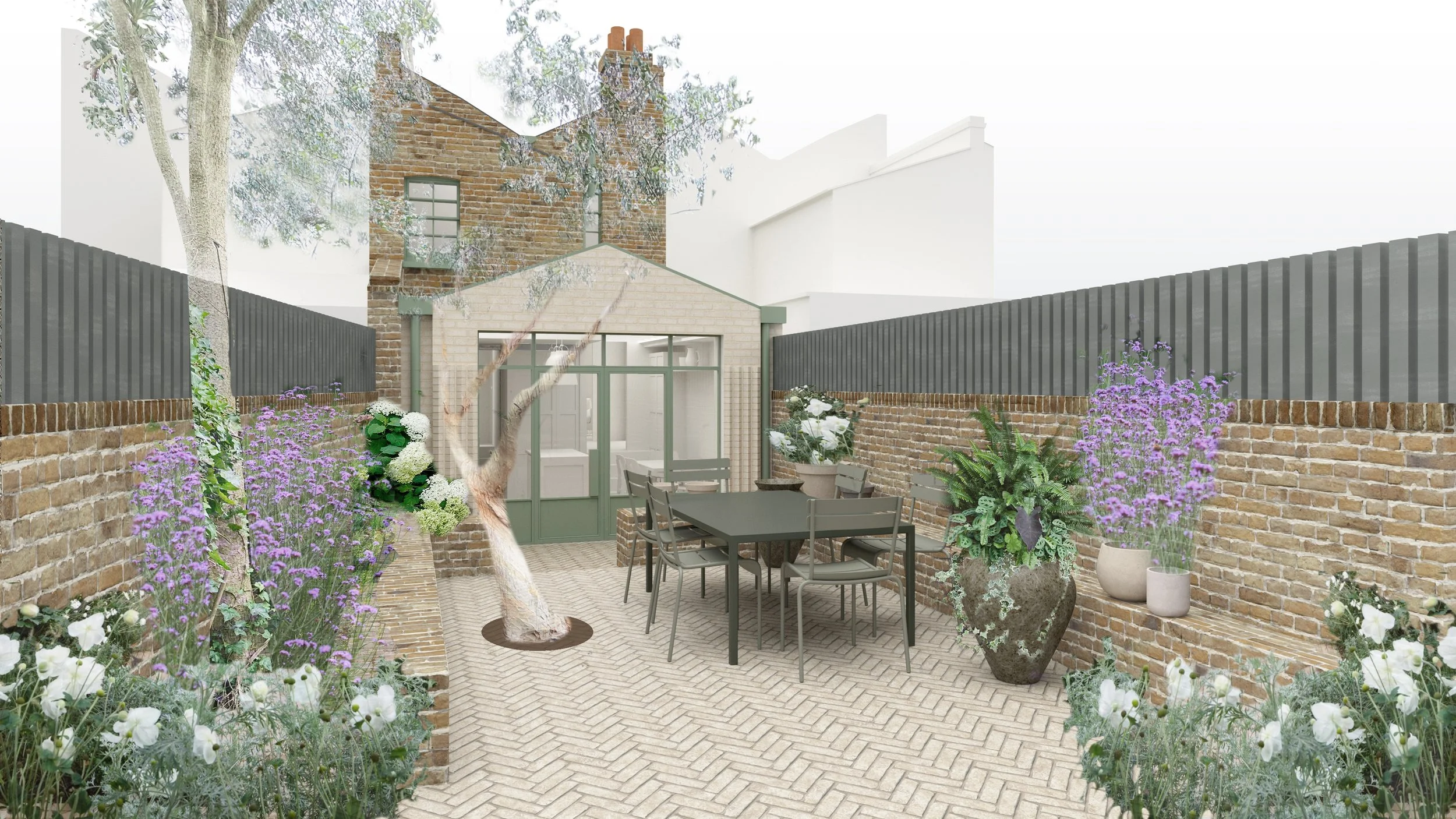
Initial submission
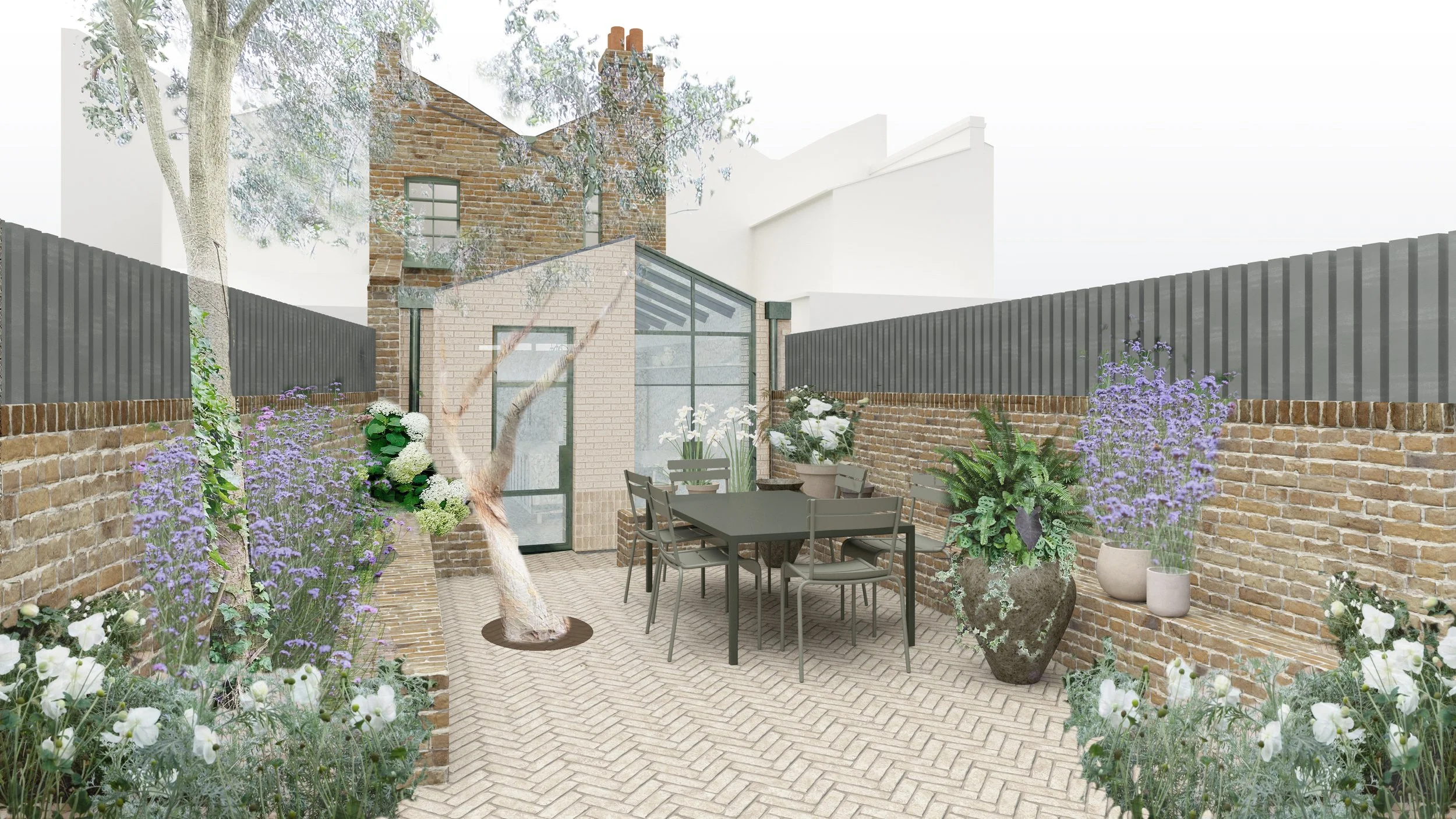
Consented design
The first submission and the dialogue that followed
Our first submission was a considered scheme. It proposed a wraparound flat fronted extension with roof slopes matching the host building's twenty degree pitch, clad in a buff brick selected to tie tonally with the existing London stock. The Conservation Officer responded positively to the roof geometry and the materials, but raised a concern with the massing. The wraparound, as drawn, read as a single mass at the rear, and the officer felt it should be broken down to feel more clearly subordinate and to differentiate the new infill from the heritage asset. The officer's initial position was that the side infill should be set back by almost 1.5 metres from the rear corner.
We did not concede that point. A 1.5 metre setback would have meant a significant loss of internal area for our client. We argued instead that subordination and differentiation could be achieved through a change of material rather than a deep physical setback. By making the infill a lightweight glazed structure in green steel framing, contrasting clearly with the brick of the rebuilt rear volume, the differentiation the policy sought was delivered visually rather than dimensionally. The setback was reduced to two hundred millimetres. The internal area was largely retained.
The officer's underlying concern was the protection of the rhythm of solid and void along the historic terrace, an objective set out in Lambeth's Building Alterations and Extensions SPD. Our argument back was evidential. The rear of this row, we demonstrated through site survey and photography of the neighbouring properties at the row's other addresses, no longer carried that rhythm. Decades of ad hoc additions had left a varied collection of single and two storey extensions in differing styles and quality. We described the result, in our submission, as a palimpsest of the spatial needs of successive owners. The original rhythm at the rear no longer existed to be protected. The neighbour engagement, described below, supported that case directly.
Two volumes, sharper differentiation
The refined scheme presented two distinct volumes where one had been before. The rebuilt rear volume became a solid brick form with a single punched opening for a door. The side infill became a lightweight glazed structure in green steel framing, set back 200mm from the corner so its subordination was unambiguous. The materials and roof geometry of the original submission were retained.
When constraint becomes gift
What the breakdown of volume gave the planning case in subordination, it also gave the house in something less measurable. The glazed infill, originally a concession to differentiation, became the device through which the eucalyptus tree at the centre of the garden is now framed and viewed from the dining space inside. The constraint and the gift turned out to be the same thing.

The neighbour engagement that made the difference
What made Eucalyptus House different from many planning revisions was the work done away from the drawing board. Our client was passionate about her neighbourhood and the row of terraces in which her house sits. She was on first name terms with everyone on the path. We encouraged her to share the revised drawings with each of them.
What followed was unusual. Five neighbours along the row each provided a written letter of support. Several allowed us into their homes to photograph their own rear extensions, not as design precedent but as evidence of the varied character of the row. The Conservation Officer's case officer received not a planning argument from architects, but a portrait of a community that had read the proposal carefully and chosen to back it.
This is the kind of work that does not appear in many architectural case studies because it does not look like architecture. It is, in our experience, often what makes the difference between consent and refusal in sensitive Conservation Areas. Heritage stewardship and openness and collaboration are the values we lead with, and at Eucalyptus House they did the heavy lifting.
Planning permission was granted in November 2021.
A separate application for solar panels
Two years later, with the main works complete, we submitted a second, separate application for eight roof mounted photovoltaic panels. This was deliberate.
There is a temptation on Conservation Area projects to load every desired intervention into a single application, on the logic that one decision is simpler than two. In our experience, this approach often achieves the opposite. Bundling controversial elements together can stall the entire scheme over a single contested item, and it can delay the start of construction by months while officers work through cumulative concerns.
By separating the photovoltaic panels into their own application, we removed any risk of them complicating the main consent. The principal works could begin on programme, the panels could be considered on their own merits, and our client did not have to wait for either. The strategy is one we apply often: stage applications to de-risk timeline, isolate contention, and allow each element to be assessed cleanly. Permission for the panels was granted in December 2023.
A fabric-first retrofit
Beyond the consent, the project delivered substantive sustainability gains for a Victorian envelope. The single glazed timber sash windows were replaced with historically accurate double glazed sashes carrying true glazing bars. The previously uninsulated first floor roof was insulated. Rooflights and boiler were upgraded. At construction stage, breathable wood fibre insulation and lime render were applied throughout the existing masonry walls to improve thermal performance without trapping moisture in walls that were never built to be sealed. The photovoltaic consent added active generation to the fabric-first retrofit.
The tree that named the house
The eucalyptus tree, the reason the house carries the name it does, stayed where it was. Mature trees on clay soils draw water from the ground, causing seasonal soil movement that can stress shallow foundations and lead to subsidence. Specially designed deep foundations, coordinated with the structural engineer, transferred loads below this zone of movement. Excavation was carried out by hand under a monitoring brief that ensured no large roots were severed. None were.
Why this kind of work matters
Heritage buildings hold stories worth continuing. The row Eucalyptus House sits within is not statutorily listed. It is unlikely ever to be. But it makes a positive contribution to its Conservation Area, and the row holds a small fragment of mid-Victorian London that is genuinely worth keeping. A scheme that improved this house without weakening that contribution was the only acceptable outcome.
Through thoughtful design we ensure these spaces remain vibrant, sustainable and relevant for future generations. The work at Eucalyptus House was not a refurbishment in the conventional sense. It was a quiet negotiation: between solid and void, between client desire and policy constraint, between a tree and the building that needed to grow around it. The result is a home that honours the past and is built for the future.
Frequently asked questions
Was the property listed?
The property is not statutorily or locally listed, but sits within the Trinity Gardens Conservation Area and is identified in the Lambeth Conservation Area Character Appraisal as making a positive contribution to it.
Did the project require planning permission?
Yes. Householder planning permission and consent for demolition in a Conservation Area were both required, and were granted by the London Borough of Lambeth in November 2021.
Who led the heritage and conservation work?
Julia Hamson, founder of 4SA and a RIBA accredited Conservation Architect with over twenty years of experience working on existing buildings, led the heritage assessment and the planning case.
How was the planning argument made?
We demonstrated through site survey and photographs of the neighbouring properties that the rhythm of solid and void along the rear of this row no longer existed, having been altered over decades by varied ad hoc extensions. This evidence underpinned our case for the glazed infill and was supported by letters from five neighbours.
How did the design protect the existing eucalyptus tree?
Specially designed deep foundations were coordinated with a structural engineer to reach below the zone of seasonal moisture movement caused by the tree's roots, avoiding the subsidence risk that mature trees pose to shallow foundations on clay soils. Excavation was carried out by hand under a monitoring brief that ensured no large roots were severed.
Why were the photovoltaic panels submitted as a separate application?
To de-risk the planning timeline. Bundling all interventions into a single application can stall the entire scheme over one contested element. By isolating the panels, the main works proceeded on programme and the panels were assessed on their own merits. Permission was granted in December 2023.
What sustainability measures were delivered?
Historically accurate double glazed timber sash windows, insulation of the previously uninsulated first floor roof, an upgraded boiler and rooflights, breathable wood fibre insulation and lime render to the existing masonry walls applied at construction stage, and eight roof mounted photovoltaic panels consented in 2023.
Where is the project located?
Brixton, in the London Borough of Lambeth, within the Trinity Gardens Conservation Area.
What RIBA stages did 4SA deliver?
Stages 1 to 7.